CONSUMER GOODS / BABY CARE
Parents judge a diaper by what they can see and feel — how thick it is, how soft, what is printed on the wrapper. The details that actually decide whether it works are set in small type and buried between the layers.
A baby gets through an astonishing number of diapers in the first two or three years — several thousand of them, by most estimates. They are among the first things a new parent learns to buy in bulk, and among the first to produce confusion. Walk down the aisle and the choices look like a matter of taste: different colours, different characters, packs promising cloud-soft comfort or extra dryness. It is easy to assume that a thicker diaper must absorb more, or that the softest one must be the kindest to skin.
Neither assumption holds up. A diaper is defined by two things that are not obvious at a glance: the size printed on the pack and the stack of materials sealed inside it. Everything the packaging is built to sell — the printed character, the softness, the sense of bulk — sits on top of that basic structure. Once you know what to look for, the choice stops being a guess.
The single most common source of leaks and discomfort is a diaper that does not fit. Size is not a matter of how big the baby looks in a particular outfit; in the Chinese sizing standard, it is tied to body weight and waist measurement. The familiar range runs from newborn up through small, medium, large, extra large and beyond, each band corresponding to a weight interval. A medium, for instance, is generally aimed at babies roughly in the six-to-eleven-kilogram range, with each larger size adding a few kilograms.
That is why a diaper can leak on one child and work perfectly on another of the same age. Two babies of identical weight can carry very different amounts around the waist and thighs. The standard also sets a maximum waist measurement for each size, a detail that matters more than the weight band for a baby with a larger build. Signs that it is time to move up are practical rather than mathematical: red marks at the waist or thighs, tapes sitting at the outer edge, a crotch that has grown short, or leaks that appear when they did not before.
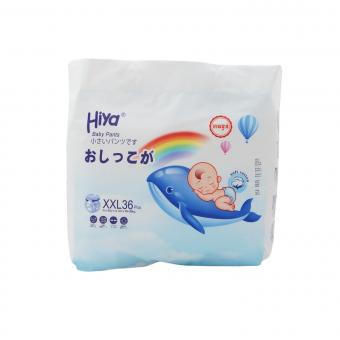
In other markets the labels are written differently but the principle is the same — check the weight range, not the picture on the pack. A diaper one size too large gaps at the legs; one size too small presses into the skin and fills too quickly. Neither can be rescued by a better absorbency claim.
Peel the idea of "a diaper" apart and it becomes a thin sandwich of layers, each with a specific job. The topsheet is the part touching the skin: a nonwoven fabric designed to pass liquid through quickly while staying soft and relatively dry to the touch. Directly beneath it sits an acquisition or distribution layer, which spreads urine sideways so the core can use its whole area rather than one saturated patch. The core itself holds the absorbent material — fluff pulp combined with superabsorbent polymer, often shortened to SAP.

SAP is the ingredient that makes a modern diaper possible. These are tiny beads of cross-linked polymer that absorb many times their own weight in liquid, turning urine into a gel that stays locked away from the skin. In clinical reviews of diaper dermatitis, the widespread adoption of these absorbent gelling materials is credited with a marked drop in moderate and severe cases, because less moisture sits against the skin and there is less friction. Underneath, a breathable backsheet lets water vapour escape while still blocking leaks, and elastic leg cuffs and a fastening system keep the whole structure positioned where it should be.
The number of layers is not a selling point in itself, and nor is thickness. What counts is how well each layer does its job and how the finished product performs as a system. A bulky diaper can still rewet at the surface; a thin one with a well-designed core and acquisition layer can stay dry for hours.
For buyers who want something more concrete than marketing language, performance is measurable. China's baby-diaper standard sets limits for three things that correspond closely to everyday experience. Absorption speed measures how quickly liquid is taken in, with a first absorption expected within about fifty seconds and a second within about a hundred. Rewet measures how much liquid comes back to the surface under pressure once the diaper has absorbed — a direct proxy for whether a baby's skin stays dry. Leakage measures what passes through the backsheet. Together these say far more than the word "ultra" on the front of a pack.
The same standard sets chemical safety limits that rarely appear in advertising: formaldehyde, heavy metals including lead, arsenic, cadmium and mercury, migratable fluorescent substances, acrylamide, phthalates and certain aromatic amines. Separate rules address the raw materials themselves. Superabsorbent polymer intended for hygiene products has its own limit on residual monomer, expressed as acrylic acid, because the beads are made through a polymerization process that can leave traces behind. Assessment by the European nonwovens association has concluded that residual acrylic acid at the levels found in diapers poses no systemic or skin toxicity risk under realistic exposure — the polymer is buried in the core, not pressed against the skin.
How all of this is regulated depends on where the diaper is sold, and the differences are larger than most shoppers realise. In China, disposable hygiene products fall under a mandatory hygiene standard that took effect in July 2025, covering microbial limits and requiring skin-irritation testing for products placed on the market for the first time. A recommended product standard covers absorption and chemical limits, while a separate mandatory standard for paper products used by infants and children took effect in January 2025 and prohibits recycled raw material.
In the United States, ordinary baby diapers are not medical devices. The federal regulation that classifies protective garments for incontinence as Class I devices explicitly states that it does not include diapers for infants. The FDA treats ordinary diapers as general-use articles: there is no pre-market approval, but claims that a product treats or prevents a medical condition can move it into a different regulatory category altogether. Oversight of lead and choking hazards sits with the consumer product safety regulator, and several states have moved towards requiring ingredient disclosure.
The European Union has no diaper-specific safety law. General product safety rules apply, which require a risk assessment, traceability markings and an economic operator established within the EU, but no CE mark — putting one on an ordinary diaper would be misleading. Chemical safety is the live issue: France's health agency has identified substances including certain fragrances, polycyclic aromatic hydrocarbons and dioxins at levels it considered worth reducing, and a restriction proposal covering formaldehyde and several contaminant groups is under discussion at EU level. A parent's practical response is uncomplicated: treat strong fragrance as a reason to look closer, not as a selling point.
Even a well-chosen diaper is only part of keeping skin healthy. Diaper dermatitis is essentially an irritant contact dermatitis, driven by prolonged exposure to moisture, friction and the contents of urine and stool. The most effective measures are unglamorous: change regularly, clean gently without harsh soap or scrubbing, pat dry, and use a barrier cream containing zinc oxide or petrolatum when the skin needs extra protection. A breathable backsheet and a well-fitting leg cuff reduce the moisture and rubbing that start the problem.

That is also why fragrance-free matters. Fragrances and some preservatives are among the more common triggers of irritation in the diaper area, and clinical guidance for sensitive or rash-prone skin recommends avoiding alcohol, added fragrance and harsh detergents in wipes. A short ingredient list is easier to assess than a long one, and any product making a skin-soothing or medical claim should be asked to show the testing behind it. Persistent redness that does not settle with careful routine is a reason to consult a paediatric professional, not to keep changing brands.
A diaper is a small, ordinary object that does a demanding job for thousands of hours without complaint. Reading it properly takes a moment: check the size against a weight range, follow the layers rather than the artwork, and treat the numbers on the test sheet as more informative than the promises on the shelf. The information is there for anyone who turns the pack over.



 Consigue una cotización